
An exploration and exhibition of the history and future of fashion embellishments
Written by Brooke Finnerty and Isabella Conti
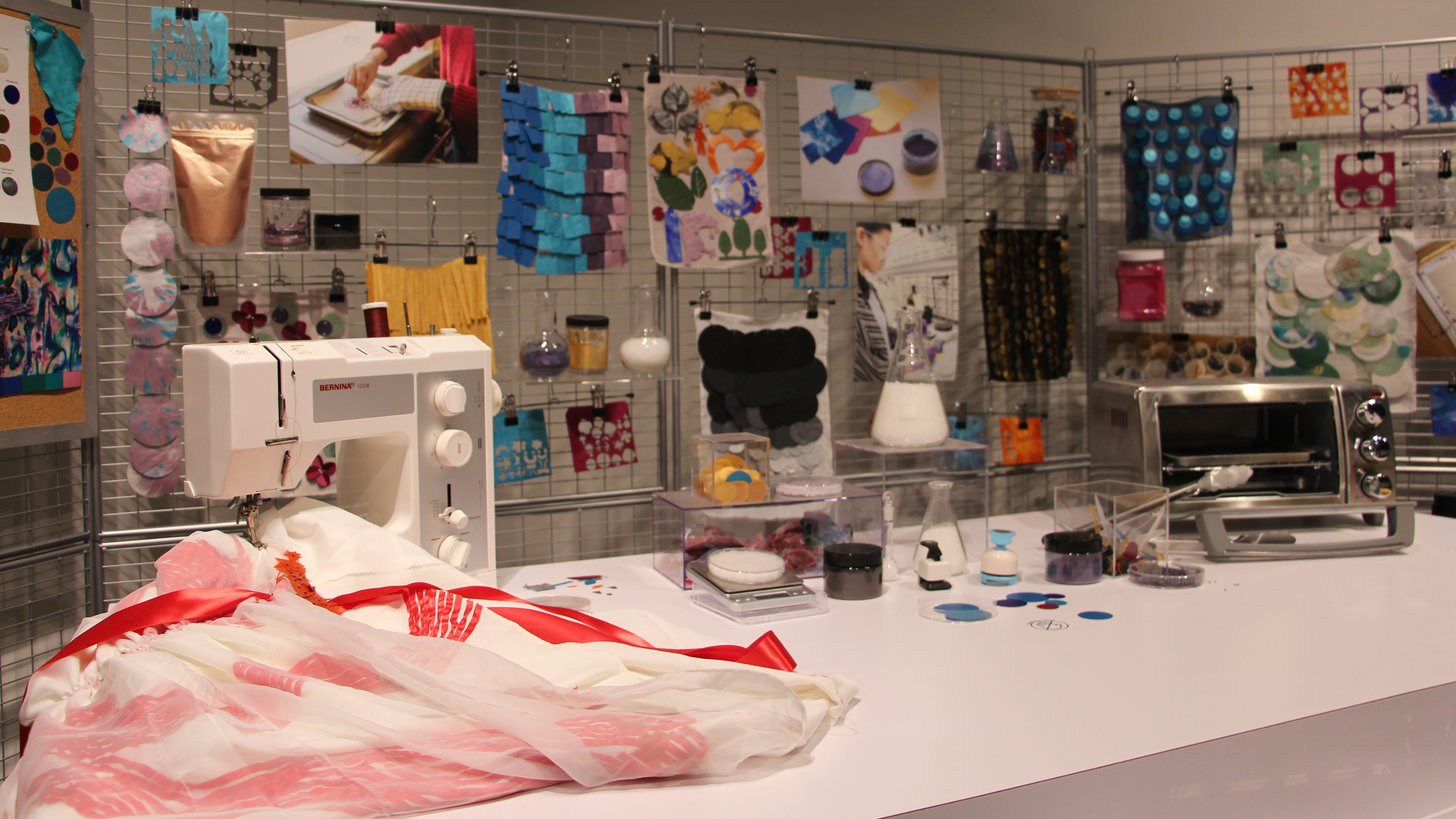
In the midst of a sustainability crisis greatly intertwined with the fashion industry, apparel designer and University of Texas at Austin professor Gail Chovan held an educational panel covering the evolution of embellishments at the UT Science & Natural History Musuem on Oct.17. Accompanied by the “Particles of Color” fashion exhibit on the fourth floor, the designs of textiles professionals and students using sustainable embellishments were showcased.

Attendees attentively listened to Chovan as she explained that 342 million barrels of petroleum are used to produce plastics for the textiles industry every year, which is important when considering nonrenewable resources in the production of clothing. Plastic in conventional petroleum based sequins contain phthalates which is harmful to human health. Sequins are then discarded into landfills and don’t break down rapidly, leading to microplastic contamination of water, air, and soil.
Fashion sustainability experts joined Chovan on stage including UT Textiles and Apparel Associate Professor of Instruction Jessica Ciarla, where she further explained her exhibit, “Particles of Color.”
Dr. Ciarla’s team created sustainable sequins made with sugars found in corn kernels. This plant product can be used to make bioplastics which are nonrenewable resources, making the sequins compostable and non-toxic.
The shapes of the sequins are created with the help of laser-cutting technology, making them customizable for any design. Their team strives for zero waste production by melting down any leftover bioplastic material to upcycle into sequins.
Dr. Ciarla discussed that the industry is extremely difficult to change but her team of students and researchers are working on a micro solution, but it can expand if everyone does their little tiny micro bits. This is a productive case study to see how the industry will incorporate sequins into their garments so they can figure out a good entryway product into the manufacturing chain.
Then maybe this can all really start to make an influence.


The exhibit bursted with color and displayed beautiful garments incorporated with sustainable sequins, from gorgeous gowns with diverse shapes to upcycled denim with mini pops of sequin.
Not only garments but accessories like purses, headwear, as well as a full glammed out pair of cowboy boots were looked at in awe. A touch of science lingered within the exhibit with test tube decorations and an immersive display where guests touched the different sequins and fabrics.
A quote from fashion designer Pharrell Williams was printed across the blank museum wall , “Fashion can be a universal player in protecting the planet.”


According to Gail, the word sequin comes from the Arabic word ‘Sikka,’ meaning coin. Many believe sewing clothes onto clothing has occurred for centuries all across the Middle East and Europe. However, the sparkly speck of plastic that we consider sequins today originated in the 1920s after the discovery of Kin Tut’s tomb, which was covered in sparkles many believe to be the oldest evidence of sequins we have.
This caused a massive increase in the sequin trend, and since then, the manufacturing of sequins has grown, further endangering our Earth through carbon emissions.
Although we can never make the fashion industry as sustainable and traditional as it was in previous centuries, we can strive to make enviornmental safe fabrics and move further from synthetic products such as polyester. Many sustainable fabrics have been developed, such as lyocell, modal, and viscose, which are pushing the industry in the right direction. Additionally, the use of recycled cotton and polyester has given companies a chance to reuse these fabrics rather than creating more.
Projects like the one these outstanding students developed with “Particles of Color,” along with discussions from this impressive panel, are exactly what we need to ensure sustainable fashion remains a priority in our minds.